Donnelley Financial Solutions (DFIN)·Q4 2025 Earnings Summary
DFIN Q4 2025: Adj. EPS Surges 75% as Software Transformation Accelerates
February 17, 2026 · by Fintool AI Agent
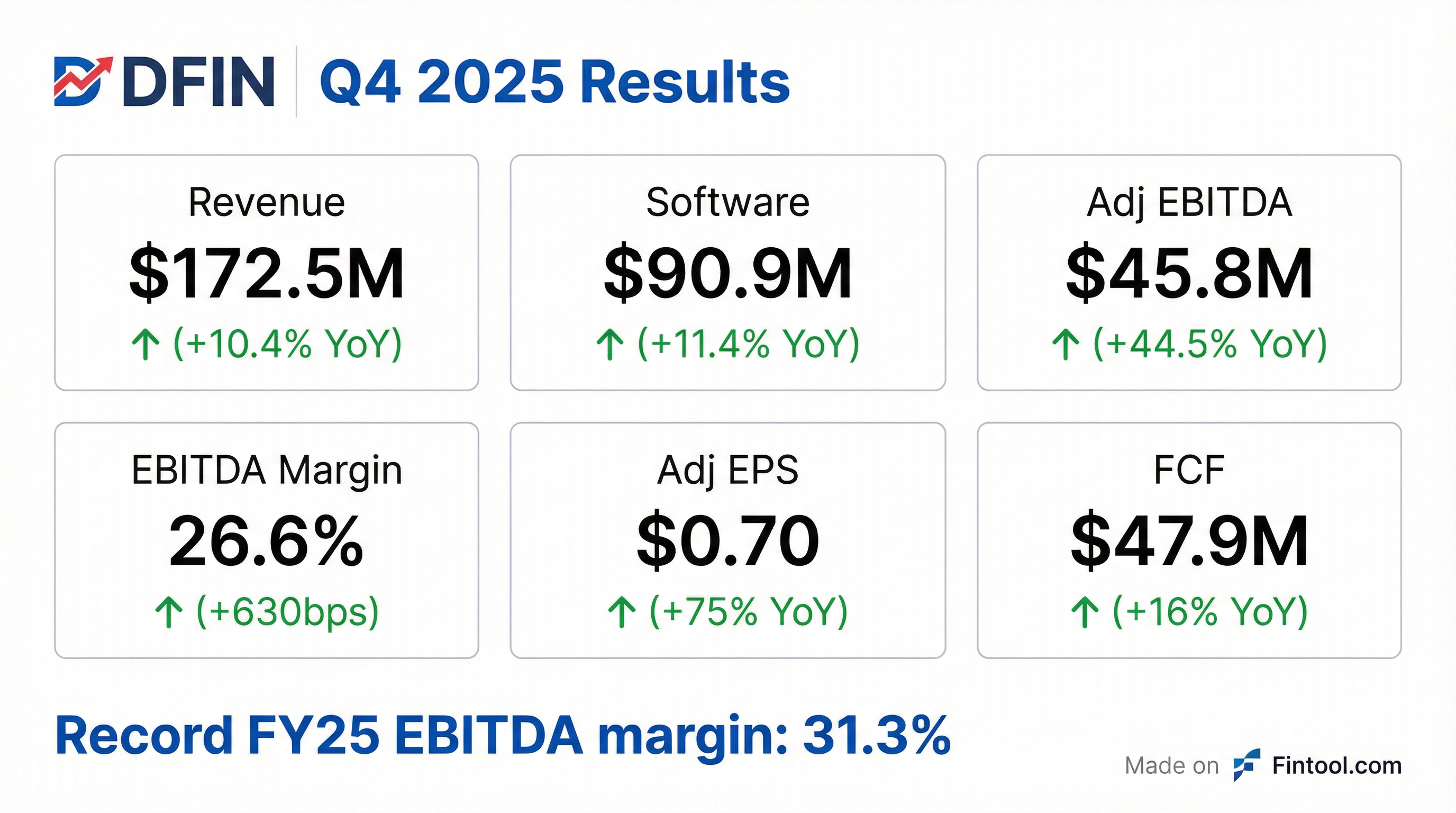
Donnelley Financial Solutions delivered a standout Q4 2025, with Adjusted EPS up 75% to $0.70 and Adjusted EBITDA surging 44% as the company's software-led transformation gains traction. Revenue grew 10.4% to $172.5M despite a challenging print market, driven by 20%+ growth in both Venue and ActiveDisclosure. Full-year software solutions now represent 47% of revenue with record EBITDA margins of 31.3%.
Did DFIN Beat Earnings?
DFIN delivered strong beats across all key metrics in Q4 2025:
The quarter was powered by capital markets transactional revenue jumping 29% YoY (+$11M), reflecting improving M&A and IPO activity. Both flagship software products—Venue (virtual data rooms) and ActiveDisclosure (SEC filing software)—grew approximately 20% in the quarter.
 Ask Fintool AI Agent
What Did Management Guide?
DFIN provided optimistic Q1 2026 guidance, signaling continued momentum:
The guidance suggests management expects the improving capital markets environment to continue. The 33-35% EBITDA margin guidance represents a significant step-up from Q4's 26.6%, reflecting seasonality where Q1 typically sees higher compliance activity.
CEO Dan Leib on "Chapter 3" transition: The company is entering "chapter three, or the sustained growth chapter of our transformation." With recurring and reoccurring revenue approaching 80% of total revenue and the remaining ~20% being event-driven, management expects "the evolution of our revenue profile towards a higher mix of predictable revenue to continue going forward...These dynamics result in sustained profitable revenue growth."
What Changed This Quarter?
1. Software transformation reached inflection point. Software solutions now represent 47% of full-year revenue, up from 42% in 2024 and just 32% in 2020. This shift is driving margin expansion as software carries significantly higher EBITDA margins (33%+) than legacy print & distribution.
2. Capital markets activity rebounded despite government shutdown. After multiple quarters of weakness, capital markets transactional revenue grew 29% YoY in Q4. The U.S. government shutdown temporarily paused transactions through mid-November, but once it ended, "we experienced a quick resumption of deal completions, driven by both the backlog of delayed deals as well as from increased market activity."
3. Aggressive capital return. DFIN repurchased $60.7M of stock in Q4 alone (1.26M shares at avg $48.38), bringing full-year repurchases to $172.3M. The company has reduced share count by 11% YoY.
4. Record profitability. Full-year Adjusted EBITDA margin hit 31.3%—a record—up 350 bps from 2024 despite soft overall revenue.
5. AI deployment accelerating. DFIN launched "Active Intelligence," an AI-enhanced capability within Active Disclosure that helps clients "streamline the research, comparison, and analysis of draft SEC filings against their own prior filings and those of selected peers." Internally, the company is deploying "agentic AI development to streamline workflows, improve productivity, and support profitable growth," particularly in product development where "improved processes and increased development velocity are enabling us to bring new solutions to market more quickly."
How Is DFIN's Business Mix Evolving?
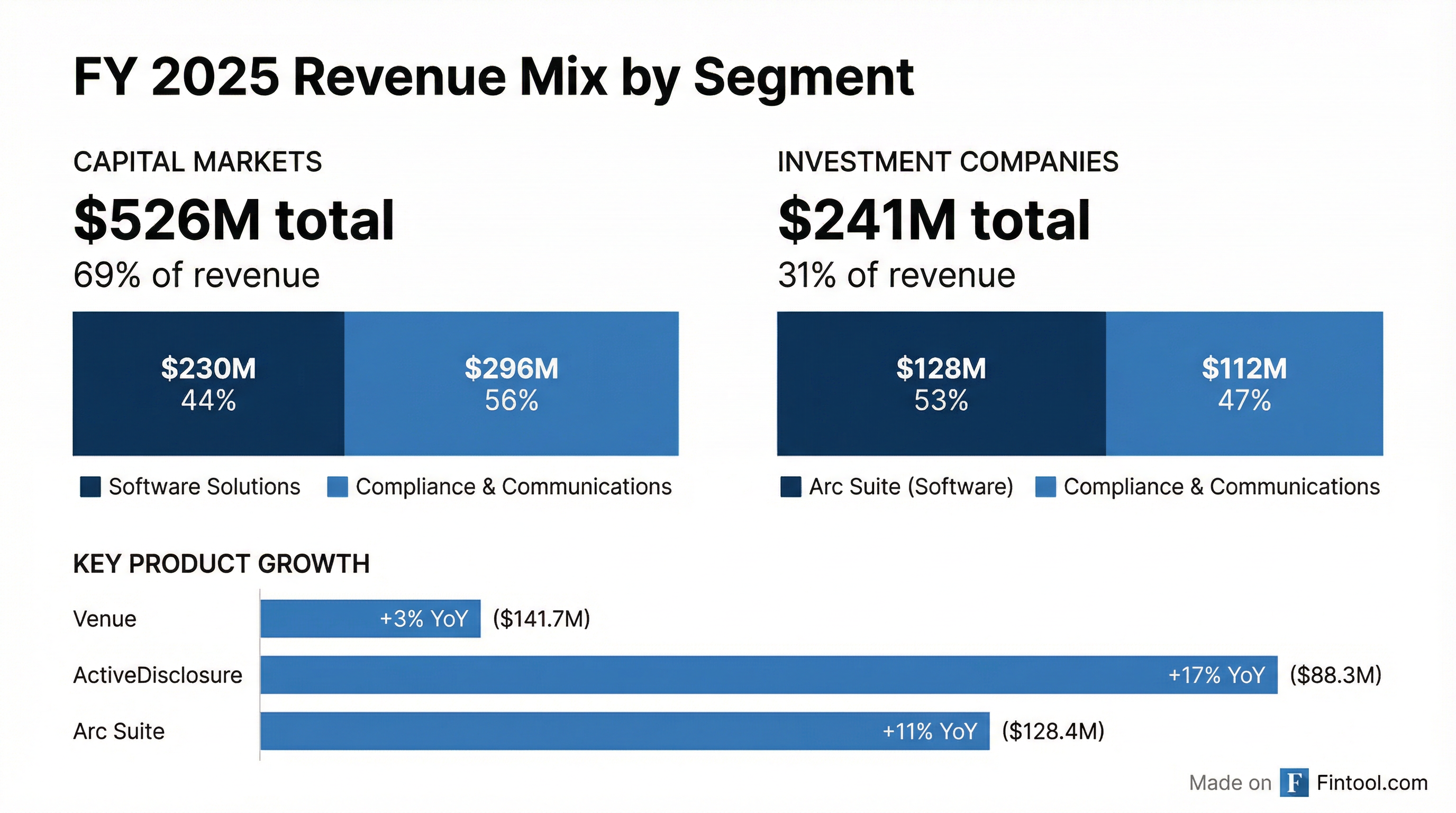
The company operates two segments—Capital Markets and Investment Companies—each with software and compliance/communications management (CCM) offerings:
Full Year 2025 Segment Performance
Key product growth rates (FY 2025):
- Venue (data rooms): $141.7M (+3% YoY, +20% in Q4)
- ActiveDisclosure (SEC filing software): $88.3M (+17% YoY, +20% in Q4)
- Arc Suite (fund compliance): $128.4M (+11% YoY)
The declining print & distribution segment ($110.3M, -16% YoY) is being more than offset by the margin benefits of the software transition.
Ask Fintool AI AgentHow Is the Balance Sheet?
DFIN maintains a fortress balance sheet with minimal leverage:
Net leverage increased modestly to 0.6x as the company drew on the revolver to fund aggressive share repurchases. At current EBITDA levels (~$240M), DFIN has ample capacity for both continued buybacks and potential M&A.
FY 2025 Capital Allocation:
- Share repurchases: $172.3M (3.56M shares at avg $48.36/share)
- Remaining buyback authorization: $53.8M
- CapEx: $57.1M
- Free cash flow: $107.8M
How Did the Stock React?
Despite strong Q4 results, DFIN shares sold off 8% on earnings day, dropping from $42.97 at open to ~$39.39 by mid-session—hitting a new 52-week low intraday.
The sell-off may reflect concerns about:
- Q1 guidance at midpoint roughly flat YoY (revenue $205M vs $201M in Q1 2025)
- ArcSuite growth expected to be "more modest" post-TSR regulation tailwind
- Broader small-cap tech sentiment weakness
The valuation disconnect is notable: DFIN trades at 5x EBITDA despite:
- Record profitability margins
- Software mix approaching 50%
- Consistent EPS beats over the past year
- Strong cash generation enabling buybacks
The company itself highlighted the attractive valuation in its investor presentation, noting the 5.0x EV/EBITDA multiple with just 0.6x net leverage.
What Did Analysts Ask? (Q&A Highlights)
On Q4 outperformance drivers (Charlie Strauser, CJS Securities): CFO Dave Gardella clarified the beat was "predominantly volume, not price"—with capital markets transactional activity stronger than expected after the mid-November government shutdown ended: "The recovery was quicker than we had expected. And then you combine that with the strong underlying activity level...made for a nice quarter."
On ArcFlex TAM vs ArcSuite (Pete Heckman, D.A. Davidson): CEO Dan Leib confirmed ArcFlex can be sold as a standalone product to alternative investment managers. EVP Eric Johnson provided context: "The private fund numbers, early 2025, is over 54,000, up 15% from the prior period...retail access is driving an expansion in the number of investors, which is really pushing the industry to need efficient production at scale."
On IPO market share (Pete Heckman): VP Craig Clay detailed strong Q4 positioning: "There were 41 companies that priced, 17 raised over $100 million. Our share of that over $100M was 65%...In the full year 2025, there were 10 offerings greater than $1 billion, and we had 70% share of that." Key deals included Medline ($6B) and Beta Technologies ($1B+).
On 2026 software growth expectations (Ross Cole, Needham): Management clarified they expect "continued strong growth from Active Disclosure and Venue" but ArcSuite growth will be "more lumpy...tied to new regulation." ArcFlex benefits are expected to start materializing in 2027, with potential tail-end 2026 contribution.
On M&A environment (Charlie Strauser): Dan Leib noted that while tech valuations have compressed, "expectations probably haven't followed as quickly...if valuations persist at a lower level with the AI overhang, then I think they will [adjust]." The company continues to evaluate opportunities.
What Are the Key Risks?
1. Capital markets cyclicality. Despite Q4 improvement, transactional revenue remains tied to IPO and M&A volumes which can be volatile.
2. Secular print decline. Print & distribution revenue fell 16% in FY25 and will continue declining, putting pressure on top-line growth even as margins improve.
3. Competition. DFIN competes with well-funded players including SS&C (Intralinks), Datasite, Workiva (ActiveDisclosure competitor), and Broadridge.
4. Regulatory changes. SEC rule changes (like 30e-3 and 498A) have impacted Investment Companies segment volumes, and future regulatory shifts could affect compliance revenue.
Ask Fintool AI AgentThe Bottom Line
DFIN delivered a strong Q4 with 75% EPS growth and 630 bps of margin expansion, demonstrating the power of its software transformation. With software now 47% of revenue, record EBITDA margins, minimal leverage, and an improving capital markets backdrop, the setup heading into 2026 looks favorable. The 5x EBITDA valuation appears undemanding for a business generating $100M+ in annual free cash flow with a clear path to continued margin expansion.
Key metrics to watch:
- Software solutions growth trajectory (targeting double-digit annual growth)
- Capital markets transactional revenue as M&A/IPO activity evolves
- Continued share repurchases given low stock price vs buyback activity
- Progress toward 76% recurring/reoccurring revenue mix
View more on DFIN | Q4 2025 Earnings Presentation